
All Wrapped Up: Baka
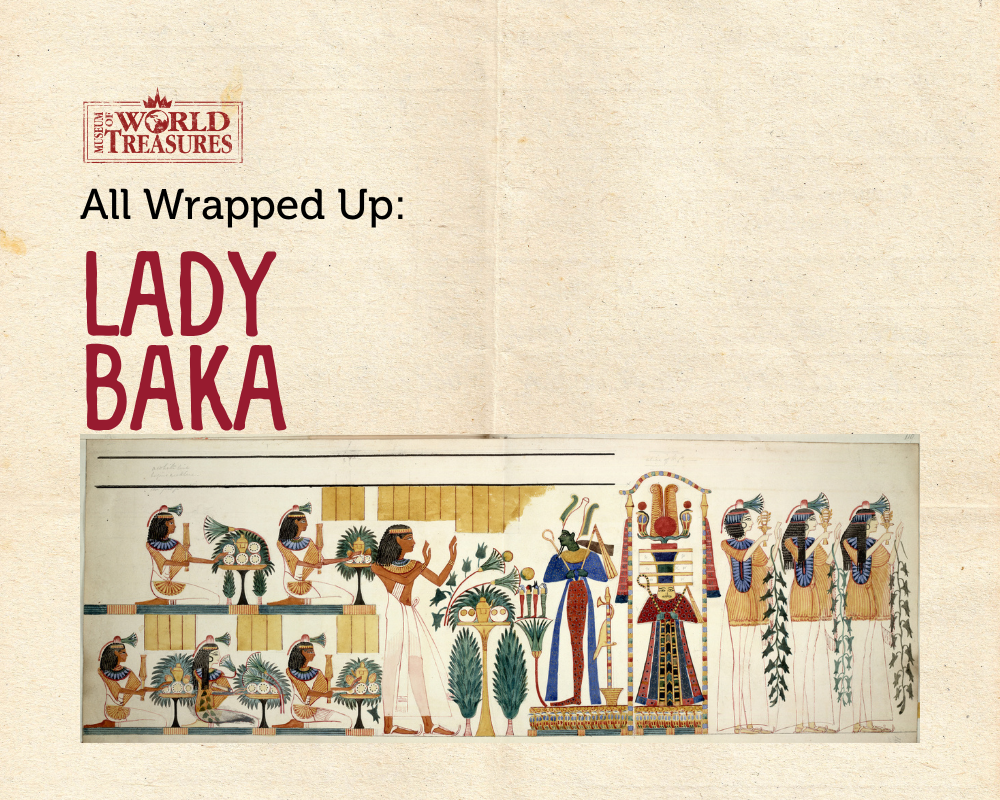
There is little known for certain about museum artifact 2019.13.002, affectionately known to staff and visitors as Baka, one of two resident mummies. And that is unfortunately all too common for many Egyptian artifacts and mummies. At the height of Egyptomania many tombs were looted and items were sold under the table, on the black market, or just scooped out of the ground by a self-proclaimed collector with no regard for the scientific processes with which modern Egyptology prides itself. Here we will share the story of our Lady Baka as best as we know it, so that you, dear reader, may know and love her as we do.
Before we dive into Lady Baka’s wonderous past, if you like what we are doing here you can support the Museum here. You can also follow us on Facebook and Instagram. Or you can join our mailing list below!
The Facts
Let us begin with the most agreed upon facts; that she was “found” by an unknown doctor from Philadelphia, PA in 1873, or maybe 1937, from a site in Thebes. Those of you who know your Ancient Egyptian history will recognize the name of the once capital city of Middle and New Kingdom Egypt. Located on the opposite bank of the Nile from modern Luxor, Thebes is home to many of the great historical sites of Egypt, like the funerary temple of Hatshepsut and the Valley of the Kings and the Valley of the Queens. Where, precisely, Lady Baka was discovered is unknown, but records are relatively certain that she was first discovered by a pair of brothers of the Abd el-Rasul family, Ahmed and Mohammed. The Philadelphia doctor brought her from Egypt to America and kept her in his collection for anywhere from 20 to 70 years, depending on when she was actually found, and then sold her to a collector named Charles Rieringer. Rieringer then sold Lady Baka to his nephew, Robert Ganter, which is where we get most of the information that we think is solid and correct. Mr. Ganter was a coin and stamp collector and was known to take Lady Baka to shows as a gimmick to attract attention to his stands. His business cards proclaimed him as the “Mummy’s Dealer.” Several attempts were made to sell off Lady Baka and her sarcophagus, only partially successful. Her sarcophagus was sold to an antique dealer from Texas, Howard Hand, and it is currently unknown where it ended up. Lady Baka was sold to an unnamed Philadelphia Museum for $200. Ganter then experienced seller's remorse and bought her back for $1,000. He then offered to sell her to the Reading Public Museum and Art Gallery but was unimpressed with their return offer of asking him to donate her to their collection and so she remained in his care. This all took place in the 1960s and 1970s.
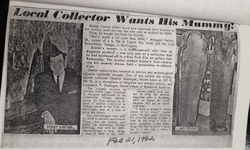
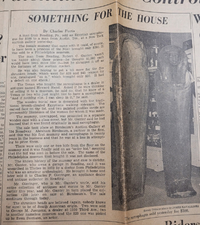
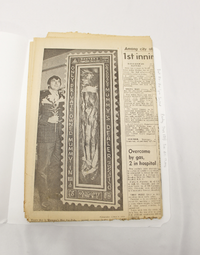
Newspaper articles from the Museum’s archives recording the sales of Lady Baka and her coffin.
Physical Attributes
The physical condition of Lady Baka is pretty good for someone who died an estimated 3,000-3,500 years ago. And given that we have records of her being shuffled around and taken to shows and displayed, the condition of her remains, and therefore the damage done to her, could be much worse.
Ganter would galivant around with Lady Baka, usually making a spectacle.
Lady Baka measures 4 '6" from head to toe, and while some of her short stature can be attributed to shrinkage from death and mummification, it’s important to remember that ancient peoples were not as tall as modern people, and so the average Ancient Egyptian female would have averaged around 5 '2". A CT study was done on both ladies circa 2012 and it was discovered that Lady Baka has a hole drilled into her head. There are two theories on why this is. One is that it was through this hole that her brain was removed for mummification after her death, which would not have been a common method at the time, though there is no evidence of nasal excerebration seen in the nasal cavity. The other is that she suffered an injury or illness and the hole was drilled to try and relieve swelling of the brain. We will never know for certain, but because of the CT we can see that the hole was mechanically drilled and not caused by a blow to the head, as there are no cracks in the surrounding bone. The hole has beveled edges that are uneven, showing that the hole was drilled sloppily. Given what we know from this CT and other scans and surveys, it is believed that Baka was between 28-31 years old when she died. Based on the quality of the mummification and the condition of the teeth, bones, and hair, the museum believes that Lady Baka was part of a family of some importance, if not possibly a member of the extended royal family. We can make this inference due to the quality of the teeth. Lady Baka’s teeth have not been worn down much, so this tells us that she would have had access to better quality food than the average citizen and likely had access to dental care. She also still has her natural hair, meaning she had access to regular bathing and hair care during a time when many of the common people would have shaved their hair and worn wigs due to ticks and inability to clean their hair. The mummification process also appears to be of the highest level available during the New Kingdom, which meant her family had the money to pay for a quality preparation and burial.
The Unknown
This is where things get murky. It is possible that The Museum of World Treasures acquired both of our mummies from the Michael C. Carlos Museum of Emory University in Atlanta, GA in 2004. Emory University records show that the mummies were acquired from the Niagara Falls Museum in 1999. Unfortunately, there are no records of what Lady Baka was doing between 1972 and 1999 or of how she ended up in the Egypt collection of the Niagara Falls Museum. Or it’s possible that only Braided Hair Lady was purchased from the Carlos Collection and that Lady Baka was purchased from Mr. Ganter directly by Dr. Jon Kardatzke. The records are unclear. Regardless, as of 2004, both of the lovely ladies have been on display here at MOWT.
Now to the mystery of where Lady Baka came from. Within the records we have access to about her past, there are a couple possible origin stories for where the mummy comes from. The name Baka is first referenced in a newspaper article from The Reading Times on October 17th, 1972. Since we do not have access to the (hopefully) original sarcophagus that Lady Baka came to the United States in, we will never know for certain what her true name is. Now one story is that Lady Baka was found with Braided Hair Lady, in a cliff side tomb, high above Hatshepsut’s funerary temple. However, it seems unlikely that this story is true, as it would be highly unlikely for them to have ended back together in a random collection after being separated for several decades. It is more likely that the mummy that was discovered with Braided Hair Lady, who will be discussed in a separate post, was sent off to a different collection and remains unknown to us.
The second theory of Lady Baka’s origin is that she was part of Deir el-Bahari Cache, or Royal Cache TT320 that was discovered ostensibly in 1881, though it is believed that artifacts were taken out by the Abd el Rasul brothers as early as 1871, because items that were later connected to this tomb were found on the antiquities market as early as 1874. The tomb contained more than 50 kings, queens, and other royal family members. The Egyptian Service of Antiquities descended on the tomb in 1881, sending Émile Brugsch, a German Egyptologist, and Ahmed Kamal, one of the first Egyptian Egyptologists, to study and explore the tomb. Spoiler alert, that is not what they did. Instead of documenting the tomb and its contents for posterity, they just removed everything within 48 hours. So, there is no record of who was laying where, or by who, or of what truly was all in the tomb. Such details could have told future Egyptologists a great deal about the tomb, and may have given us more clues on why there were 50 royal mummies all crammed in one spot.
There is at least a partial list of the names of who was all in the tomb, providing, of course, that everyone was in their original sarcophagi. Contained within this list is a mummy referred to as Baket, or Baketamun, whose name means “Handmaid of Amun,” which would be a very typical name for a "Princess of the Nile” as Baketamun is believed to have been. She is thought to be the daughter of Thutmose III, one of the most dominant Pharaohs of the New Kingdom. It is thought that there is the possibility that our Lady Baka is Princess Baket, due to the similarity in name, however we have little ability to confirm this at the present date.
Lady Baka is a good reminder that for all we may have learned from the early days of Egyptology, there was much more lost than gained due to greed and a desire to own the past. Perhaps one day we can give Lady Baka back her true name, and remember her as she was, for the Ancient Egyptians believed that names were a central part of a person’s identity, power, and soul. To have your name remembered was to be immortal, and to erase a name was to condemn a person to oblivion.
All information pulled from Museum of World Treasure files.
